
How to Connect GPS Trackers to Your Own Fleet Management Platform
Many fleet-management companies, GPS service providers and IoT solution developers already operate their own software platform.
In this situation, they do not necessarily need another GPS tracking platform. What they need is reliable GPS hardware that can communicate with their existing server and deliver the required vehicle, asset and sensor data in a stable and scalable way.
This is becoming an increasingly common requirement in professional GPS tracking projects.
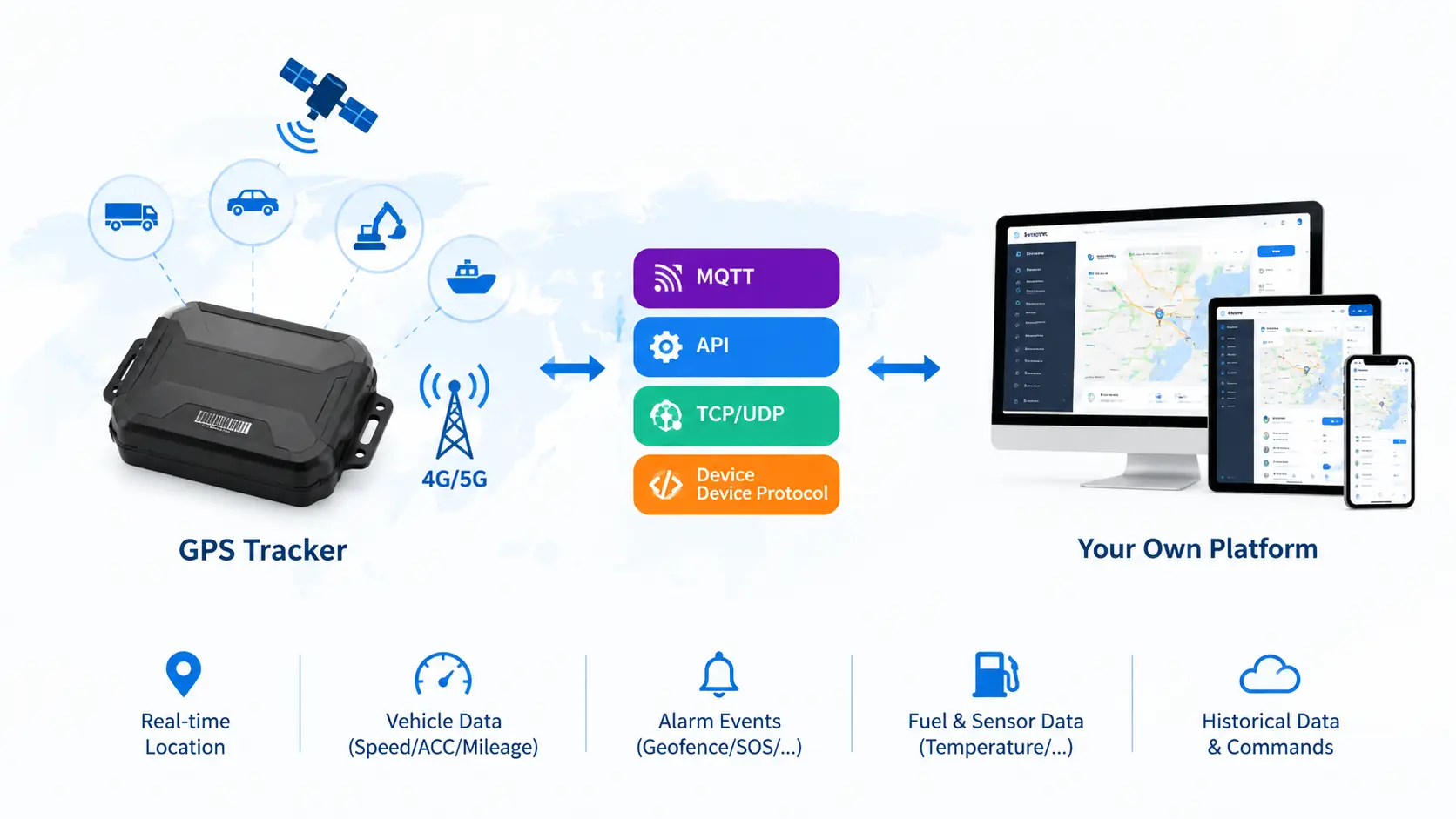
At JHGP, we work with customers that need GPS trackers to communicate with their own backend systems through API, MQTT, TCP-based protocols, data forwarding or direct device communication.
If you are building or expanding your own fleet platform, there are several integration architectures to consider.
1. API Integration
API integration is often the easiest approach when the GPS devices are already connected to an existing tracking platform.
The customer application retrieves data from the platform through an API.
Typical information may include:
- Real-time location
- Latitude and longitude
- Speed
- Ignition status
- Mileage
- Device status
- Alarm information
- Historical tracking
- Fuel-level data
- Temperature or other sensor information
API integration can be suitable for ERP systems, mobile applications, fleet dashboards and business-management software that do not need to communicate directly with every GPS device.
However, larger commercial deployments should also consider API request frequency, historical-data access and real-time-data architecture.
For projects that require higher-frequency data or greater control over device communication, other integration methods may be more suitable.
Learn more about our MQTT GPS Tracker & API Integration capabilities.
2. MQTT Integration
MQTT is widely used in modern IoT architectures because it provides an efficient publish-and-subscribe communication model.
For supported GPS tracking projects, MQTT can be used to deliver telemetry data from the tracking device or communication service to the customer's own infrastructure.
Depending on the hardware and firmware configuration, an MQTT integration project may include:
- Customer MQTT broker
- Server address and port
- Authentication
- Client ID
- Topic configuration
- Position data
- Device-status data
- Alarm messages
- Sensor information
- Remote commands
- Command acknowledgements
MQTT is particularly useful for companies already operating IoT cloud infrastructure or systems that need event-driven communication instead of frequent API polling.
MQTT or MQTTS availability depends on the selected GPS tracker and firmware configuration, so technical requirements should be confirmed during the project-evaluation stage.
3. Direct GPS Device-to-Server Connection
For GPS tracking companies that want greater control over their infrastructure, direct device communication can be an important option.
The architecture is simple:
GPS Tracker → Cellular Network → Customer Server → Customer Platform
In this model, compatible GPS devices communicate directly with the customer's server using a supported communication protocol.
Depending on the product and project requirements, communication options may include:
- TCP/IP
- GT06
- JT/T 808
- MQTT
- Custom communication protocols
This approach can reduce dependence on a third-party tracking platform and gives the customer more control over data processing, device management and platform architecture.
JHGP can provide communication-protocol support for compatible products and evaluate firmware customization for qualified projects.
If you require deeper customization, visit our GPS Tracker OEM & ODM Services.
4. Data Push and Forwarding
Another integration method is data forwarding.
Instead of the customer repeatedly requesting data through an API, the system can send tracking information to the customer's server when new data becomes available.
Depending on the system architecture, the forwarded information may include parsed data or supported original device messages.
This type of architecture can be useful for customers who need real-time vehicle or asset data but do not want their software to continuously poll a GPS platform.
What Data Can Be Integrated?
The available data depends on the GPS tracker, connected sensors and project configuration.
Typical data can include:
GPS and Location Data
- Latitude
- Longitude
- GNSS timestamp
- Speed
- Direction
- Position status
Vehicle Data
- ACC / ignition
- Mileage
- External power status
- Vehicle operating status
Alarm Data
- Overspeed
- Geofence
- SOS
- Vibration
- Power disconnect
- Movement
- Tamper events
Sensor Data
For compatible hardware, GPS terminals can also work with external sensors such as:
- Fuel-level sensors
- Temperature sensors
- Humidity sensors
- BLE accessories
- Other supported vehicle or asset sensors
The JHGP A7, for example, is designed as a flexible vehicle-tracking terminal and can support additional telematics applications through suitable interfaces and Bluetooth accessories.
Explore our GPS Tracking Devices for different vehicle and asset applications.
Which Integration Method Should You Choose?
There is no single integration architecture that is suitable for every GPS project.
API integration may be sufficient for a relatively simple business application.
MQTT may be better for a modern IoT platform requiring event-driven communication.
Direct device-to-server communication may be more suitable for a GPS tracking company that wants to control the complete communication architecture.
Before selecting the integration method, consider:
- Number of devices
- Reporting interval
- Amount of real-time data
- Historical-data requirements
- Server architecture
- Required remote commands
- Security requirements
- Existing GPS platform
- Future fleet growth
Start With Sample Integration
For professional deployments, we recommend testing the integration before mass production.
A typical process includes:
- Confirm the target country and cellular network.
- Select the GPS tracking hardware.
- Confirm the required data fields.
- Confirm API, MQTT or communication protocol.
- Configure the server and firmware.
- Test sample devices.
- Verify data parsing and remote commands.
- Perform field testing.
- Proceed to mass deployment after validation.
This reduces technical risk and allows both the GPS hardware and the customer platform to be tested under real operating conditions.
Work With a GPS Hardware Manufacturer
Software integration is easier when the hardware supplier also understands firmware, device protocols and field deployment.
JHGP is a GPS tracker manufacturer in China providing GPS tracking hardware, OEM/ODM development, firmware customization and platform-integration support for international B2B customers.
If you already operate your own fleet-management platform, GPS tracking system or IoT backend, send us your server architecture, communication requirements and required data.
Our engineering team can evaluate the most suitable hardware and integration method for your project.